Showing posts with label growing from seed. Show all posts

Monday, January 4, 2021


Coop Gardens : A Plot to Save the World


As we launch into 2021, I look forward to continuing my work as a volunteer with Coop Gardens (Cooperative Gardens Commission), which I joined in April of last year. The organization was formed in response to the COVID-19 pandemic, with the goal of distributing free garden seeds to those most in need.

Who knew what this sudden and overwhelming global emergency would bring in the next months? 

You can learn more about Coop Gardens and download their brand new report here. 

Some of the ways I tried to support local organizations are below:

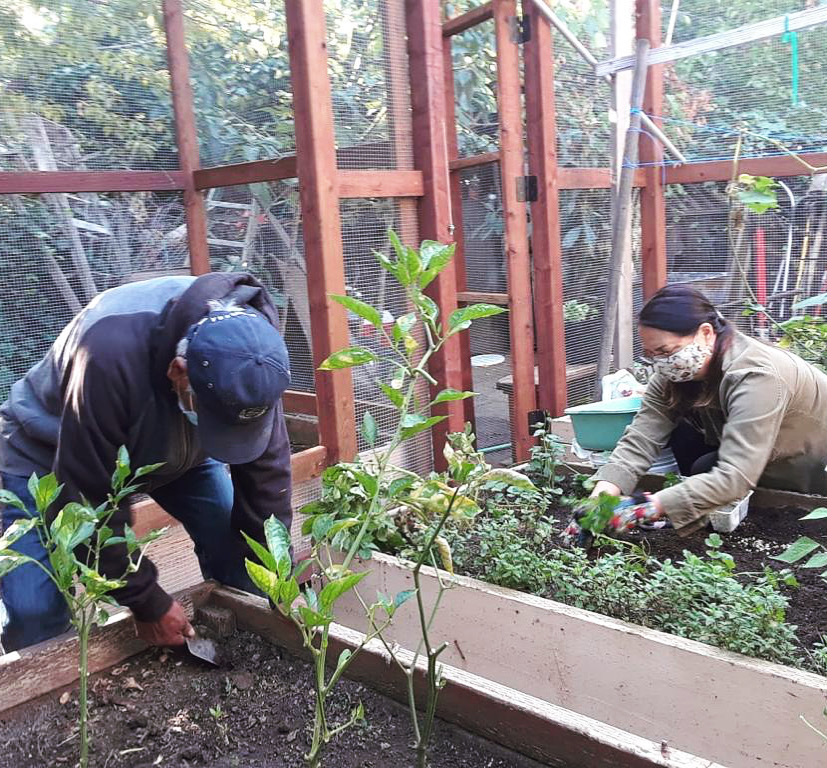
Me and Berto planting seedlings I grew, at the Day Workers Center in Mountain View, CA

Not everyone has the luxury of land in which to grow their own food garden, so I propagated seedlings to plant at the Day Workers Center. They provide such valuable services for day laborers, including meals twice daily. 


Seeds packaged and ready to deliver to La Mesa Verde, San Jose, CA

La Mesa Verde runs a wonderful and inspiring program that installs  raised beds for vegetable gardens in the homes of people in need, and provide training for new gardeners- find them on YouTube and see their videos in Spanish and English here.


                                                                        Photos: Patricia Larenas, Urban Artichoke


Tuesday, July 3, 2012

The Rewards of a Seedy Garden

-->

If you don't let your edibles flower and make seeds you are missing out on some great perks: free seeds, spices, and pest management. But there seems to be an unwritten rule that in the tidy urban or suburban garden lettuce shouldn’t be allowed to bolt or parsley let go to flower. 

Who wants a seedy garden? I do, for one.

The Beauty and Power of Seeds
Landscaping with edibles sometimes involves shifting our ideas about what a garden should look like, especially the front yard. The first time I let my lettuce bolt I watched with fascination how it shot up several feet high in a vigorous tower, then quickly produced abundant tiny flowers. A passerby asked "What is that? It’s beautiful!".

Before that experience I had no idea that lettuce produced flowers and seeds that could be collected and saved for my next lettuce crop. It felt empowering - getting free seeds was in my grasp!

Green cilantro seeds (coriander) are spicy

Seeds with a Bonus - Stock Your Spice Rack
With some edibles, letting the plant set seeds provides an extra bonus.  Cilantro and dill are popular herbs whose leaves are what most gardeners and cooks are after, but by letting them go to seed we get a second product for our kitchen - their seeds for cooking. Cilantro, also known as coriander, has small green fruits that are incredibly fragrant and citrusy. 

Try cooking them in a stir fry or with sauteed vegetables.  They're especially good in curried dishes. Let some of the fruits dry completely and grind with a mortar and pestle to use them in recipes.

Other seeds to save for cooking are fennel and lovage seeds. Store the seeds whole in small jars with lids. Recycled spice jars are perfect. And the next time you are in the grocery store make sure you check on how much money you're saving by collecting your own spice seeds. Spices are expensive and they usually aren't very fresh unless you buy from a specialty supplier.

Flowering parsley is pretty and a powerful magnet for beneficial insects

Fight Garden Pests with Flowers
The flowers of many vegetables and herbs are highly attractive to pollinators and other beneficial insects. Parsley flowers are huge magnets for hover flies and tiny predators such as tachinid flies and parasitic wasps. Watch closely and you will see them going to work for you in the garden keeping pests under control. 

In fact, using certain plants to attract beneficial insects is a well-known strategy of Integrated Pest Management (IPM) for organic and sustainable gardening, instead of using pesticides.

Enjoy the full benefits of your edible landscape by letting it go to seed. Once you experience the magic of your flowering edibles you'll become a convert, I promise!

A version of this post was published on Eat Drink Better 

Photos: Patricia Larenas, Urban Artichoke

Tuesday, April 10, 2012

Using a Cold Frame to Start Your Summer garden

-->
You can build your own or buy a cold frame that is a mini-greenhouse

Using a cold frame is a fantastic low-tech way to start your seeds for a summer vegetable garden ahead of the summer/spring growing season.

I mentioned using a cold frame in my previous posts, How to Grow From Seeds and Growing and Transplanting Seedlings.  A cold frame can be used in different ways and will give you more flexibility in starting your plants for a summer vegetable garden. Even if you have a long growing season, you'll have your yummy veggies on the table earlier in the summer than if you wait to sow your seeds directly in the soil.

What is a Cold Frame?
Cold frames are a great low-tech way to create a protected mini-environment for cold sensitive plants. They can be made with wooden sides, with a glass lid using old windows, or with fiberglass or plastic (polycarbonate or acrylic) sheets to let in sunlight. Some are made entirely of plastic or glass, like a small greenhouse. The top is movable for venting, because cold frames will heat up quickly (think of how fast your car heats up with all the windows rolled up). You will need to prop the top open varying degrees, and it’s also helpful to be able to remove it. They can be set on bare ground over a planting bed, or on paved areas. They are generally small for home use, about 4 to 6 feet long, 2 to 3 feet wide, and 1-2 feet high.

My cold frame is a Juwel BioStar 1500 with polycarbonate panels, and beagle proof!

-->
Managing the Cold Frame Environment
Place your cold frame in an area that gets the most hours of direct sunlight. On sunny days you’ll have to be very careful to prop the cold frame’s top open so that your plants (especially tender young seedlings) don’t dry out or get damaged by too much heat. You can start to acclimate your seedlings to ambient temperatures by propping the lid open just an inch or two at first on cold days, then wider as it gets warmer.

I leave it closed up at night, and prop the top open (or remove it) when the sun starts to hit the structure, depending on the air temperature. If it’s below 60° F and cloudy I leave the top on, but propped open. At 60° F and above I’ll remove the top until the sun sets, then put it back on for the night. For daytime temperatures on in the 40's and lower you may just leave it closed. High humidity could cause problems fungal diseases, but if temperatures are cool, it’s less likely.

Check your young plants for moisture at least every day, and more often if the cold frame is warm. If you are germinating seeds, remember that they have to remain evenly moist at all times.

Save $$ by Growing Your Own
If you like growing vegetables from seed I think you'll discover as I did, that a cold frame is a fantastic way to have nursery-quality seedlings ready for your summer vegetable garden when planting time rolls around.

 This post was also published on Eat Drink Better.

Photos: Patricia Larenas, Urban Artichoke

Monday, November 14, 2011

Heirloom Bean Project Wrap Up


Growing Heirloom Beans
Last summer I grew several bean varieties for my self-designed heirloom bean trial; my goal was to see which grew best and to choose a few to expand in the next season. I want to grow enough to have dry beans for cooking over the winter. Why the excitement? I think it's fantastic to be able to grow a tasty and healthy protein source in my own suburban back and front yards. Besides that, I love the versatility of cooking with beans, and the varieties are endless if you venture beyond the grocery store.

Home grown: Good Mother Stallard, Cranberry, and Italian Butter beans (left to right)

Bean Trial Results

Now that it’s fall the results are in: a total yield of almost four pounds of beautiful dry beans of several types. That's more than I expected since I didn't grow very many of any one type for my trial. In all I tested seven runner beans and five varieties of common beans.

Runner bean varieties: Scarlet Runner, Ayocote Morado, Ayocote Negro, Alubia Criollo, Cannelini Runner, and Gigandes.

Common beans: Cranberry, Hutterite Soup, Good Mother Stallard, Tiger's Eye, and Hidatsa Shield Figure. 

The seeds came from three sources, Rancho Gordo, Iacopi Farms, or Seed Savers Exchange.

Another motivation for growing some of these is that they are not widely commercially available. You won’t find most of these, if any, in your supermarket. It’s extremely satisfying to be able to propagate them on a small amount of land, my suburban garden for example. I highly value being part of the grassroots movement to grow lesser known food plants to keep them from extinction.

A trellis of  Italian Butter beans attracted many types of pollinators

Favorite Beans to Grow

It's going to be hard to choose only a few types to grow in quantity next summer, but I do have some favorites. We loved the Italian Butter Bean from Iacopi Farms in Half Moon Bay, near the SF Bay Area. Iacopi Farms sell at our farmer’s market every Sunday, and they are the only vendor with dried beans for sale. I grew about 18 plants around two trellises in our front yard, which attracted a lot of bees. It turns out that the vines are beautiful, vigorous, and produce an abundance of long lasting cascading white flowers. I enjoyed telling admiring passersby that these lovely vines were actually bean plants! I harvested almost a pound of dry beans.

Italian Butter beans sauteed in olive oil with fresh corn and garden basil
The cooked beans are creamy and luscious when sauteed in olive oil with freshly cut sweet corn off the cob and fresh garden basil or tarragon. Other favorites are the Hidatsa Shield Figure and Tiger's Eye. These beautiful rare beans have intriguing histories. The Hidatsa Shield Figure bean was grown by the Hidatsa tribe in the Great Plains region, and Tiger's Eye is a new world bean that originated in Argentina or Chile. It's worth expanding the small amount of seeds I got into a bigger crop next year.
But for now, I look forward to enjoying my dry beans well into the winter with tasty satisfying dishes.
Photos by Urban Artichoke
This post published @: EAT, DRINK, BETTER
 

Friday, April 2, 2010

Spring Starts

This year I tried starting my plants from seed. I've done that a bit in the past, but only with the really easy stuff- like string beans. I don't know why I thought it would be so difficult- surprise! It's not hard to do, for most of the plants I've tried so far. I have spent a lot of money buying seedlings in my lifetime so I thought it would be smart to save some money, plus I love growing things: I find it very satisfying and extremely addicting. Even though I live in the San Francisco Bay Area where the winters are pretty mild, we still get night temperatures into the 30's and maybe 20's, with frost. So that means even though we have a very long growing season and an early spring, most edibles are best started indoors if the night time temperatures are not reliably into the 50's (I just learned this). Since I don't have a green house or cold frame (do we really need these in our area you might ask?), I tried it out in the bay window of our dining room. As you can see in the picture, this is not very many plants, but it's a start- I ran out of room quickly! I used potting mix and an assortment of left over six-pack and other small containers saved from my purchases. The real secret to success is to keep the starts moist, and don't let them dry out (Renee's Garden web site has some tips with photos).


I started two kinds of sunflowers in February (too early I think), and these can be transferred outside soon. "Lemon Queen" is one I loved last year. It is a multi-branching type that gets lots of flowers about 5 to 6 inches across. They have pollen, so the bees love them too, in fact it is a highly recommended plant for attracting bees to the garden by the Great Sunflower Project (this is a volunteer participatory effort to gather data on bees). It makes a stunning addition to the summer garden. I'm trying "Chocolate Cherry" also, which has maroon flowers of the same multi-branching type, but sadly, no pollen.  I've also started some Roman chamomile, the herbal kind, not the ornamental ground cover. I bought a small plant last fall and I love the wonderful apple-like scent of the foliage, and it produces a profusion of flowers to harvest for tea. The seeds sprouted easily indoors in plain potting mix.

I recently bought some seed packets at my favorite garden supply store, Common Ground. The seeds are from Renee's Garden. She has wonderful special varieties of flowers, herbs and vegetables, so I bought a bunch. This is Renee Shepherd, who also writes articles for gardening magazines and has a great web site. I was so inspired by her article on growing zinnias that I bought some of her zinnia varieties, and the couple I tried so far (Persian Carpet and Apricot Blush) have started just fine. She also notes how to collect and store the seeds for the next season's planting. The article is in a special edition magazine Starting from Seed published by Fine Gardening Magazine. It has lots of tips and how-to on seed collection and starting plants from seeds.

Other seeds I tried were her "Baby Mesculin Salad- Paris Market Mix". We are salad fiends in my family, and my goal is to keep a supply of salad greens in the garden all year round. (I was amazed to find that lettuce and other greens are not damaged by frost, at least where I live.) I sowed these directly outside in a barrel planter (covered with mesh to protect it from our bird neighbors).


The seedlings have already come up. This barrel has been great for some added space to grow lettuce and other greens that prefer cool temperatures. It sits under our silk tree, so it has some shade on hot summer days, and sun in the winter when the tree drops it's leaves.

To keep up the early spring spirit, I recently started some divisions of our beloved globe artichoke. It is in it's second year, and is actually made up of about 3 to 4 plants now. It produces twice a year, in spring and fall, and yields a surprising amount of artichokes, (which I tend to buy weekly when they are available). You can see my two starts in the picture below- one is for a friend, with whom we share plants and produce back and forth every year, and one is for my mother and sister's garden in Santa Cruz.


Speaking of sharing, another neighbor who lives down the street from us has a lovely place on the corner, and I always admired their gardens. They have a diversity of plants, minimal lawns, and a beautiful mini orchard on the side of the house (below). The picture shows how the young apple and citrus trees are leafing out. What a great use of front yard space! But they also have borage in the yard,


which I have been wanting to introduce into my own front yard. It attracts bees and it is said to be a beneficial companion plant, and may repel tomato worms (John Jeavons). The beautiful blue flowers are edible too. Since it self seeds easily, I didn't even want to spend money on a seed packet, so I asked our kind neighbors if I could take a small bunch from their garden. Of course they obliged right away, so I showed up with my spade and a bucket, and she grabbed a shovel and gave me a couple of big clumps (a liberty I was too shy to take in her garden!).  Here is a picture of her borage in full bloom below, looking lovely amid the irises and California poppies. The borage is the plant with fuzzy looking stems and small star-like blue flowers. She told me that she had brought home another plant from her mother's garden, and the borage came as a tag-a-long and established itself in her garden. We got to chatting and she ended up giving me a dozen eggs from her family's ranch in Monterey, where her family has lived for 150 years. It was wonderful to share our love of plants and passion for gardening.

What a great start to spring...