Monday, October 24, 2011

Be Your Own Seed Bank: How to Save Seeds

My saved seeds from the lovely Hidatsa Shield Figure bean
As we celebrate World Food Day on October 24th, I’m especially thankful for one of life’s most precious gifts: seeds. Seeds are magical and mysterious in that our future rests in them. Without the thousands of varieties of useful plants we cultivate for their products, human civilization would simply cease. We could no longer feed ourselves nor our animals.

Preventing the extinction of a wide variety of food plants is not just romantic and historically interesting, it’s a matter of ensuring a healthy future for humanity. As industrial agriculture becomes increasingly focused on growing fewer and fewer varieties of food plants, home gardeners play an unexpected important role in propagating and saving old varieties of vegetables, fruit, and herbs by continuing to grow them, sharing the seeds and providing the seeds to organizations such as Seed Savers Exchange. Native Seeds Search is another important seed stewarding organization- they specialize in crops of arid regions (South Western USA), and prioritize providing heritage seeds to Native Americans.

Label your saved seeds carefully; you'll be thankful when its planting time!
Seed Saving Basics
If you have never had the pleasure of saving seeds and planting them the next season you are missing one of life’s simple and deeply gratifying pleasures. Fall signals the prime time for saving seeds and it is not difficult for many popular garden plants; all you need to know are a few basics. Try starting with easy seeds such as beans, nasturtiums, and basil, for example.

First, remember that the plant you intend to save seeds from must be an open pollinated type and not a hybrid. If it is an heirloom type it is open pollinated.

Follow these key steps:

1) Make sure you let the seeds stay on the plant until they reach full maturity. For example: if you pick bean pods while they are still green you may as well eat them, because the seeds won’t germinate!

2) Let mature seed pods or flower heads dry on the plant as much as possible. The timing is tricky in some cases because you need to collect the pod or flower head before it begins to release its seeds. In general, wild plants disperse seeds very efficiently with clever spring-loaded pods (poppies) or flower heads that fall apart readily to be transported by animals or blown away (dandelions). Domesticated agricultural plants were bred and selected for seed collection and for food harvesting, so the pods stay intact.

3) After collection and harvesting the seed pods or flower heads must dried completely. This is very important to prevent mold and spoilage. I like to keep my harvested collection in an open container in the house for a couple of weeks to make sure they dry out before extracting the actual seeds. Choose a cool dry spot out of direct sunlight.

4) Next, remove the seeds being careful not to damage them, and discard any debris. At this point I leave them to dry some more (a week or two) then store in a labeled airtight container. If I have a small number of seeds of different types I put them into labeled envelopes then put these into a jar with a lid.

Calendula flower seeds from a dried seed head.
It's a good practice to get in the habit of labeling your seeds with basic information that will be very helpful later such as: the exact name of the variety, where you got the parent plant or original seeds, and the year of collection. You'll be amazed at how fast your collection will grow, and you'll enjoy sharing them.

There are good reasons for saving the seeds of your favorite food plants besides just the fun of it: perhaps you have a special heirloom variety that is in limited supply, or one given to you by a neighbor. Saving the seeds allows you to expand the number of plants for next year’s planting season, or to share them with others for years to come.

You might even create a new variety or cultivar from natural crossbreeding in your garden!

But most importantly, you will be a a part of a growing movement to save our agricultural biodiversity, all from your own home garden.

Monday, September 26, 2011

Jerusalem Artichokes: An American Native

Jerusalem Artichokes, (Helianthus tuberosus) a.k.a. Sunchokes, are actually in the sunflower family and native to North America. They aren't related to artichokes and didn't originate in Jerusalem, but their edible tubers do have a wonderful artichoke-like flavor.

Sunchoke tubers with globe artichokes: they aren't related!

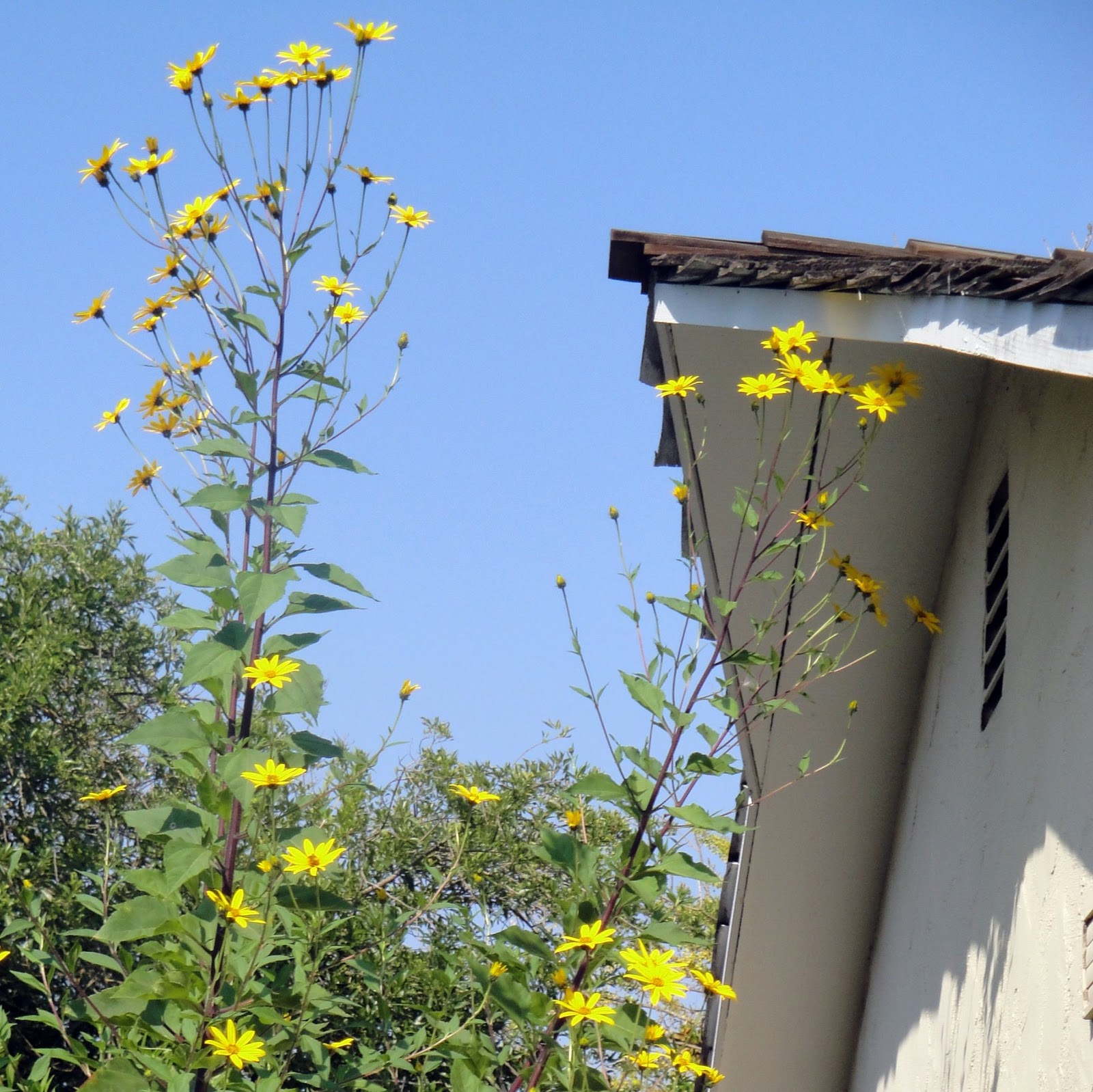
They are very easy to grow and are crispy when raw in salads, and tasty cooked and pureed into a soup, mashed, or sauteed. If you like the taste, they are a great addition to your edible landscape. And as a bonus, Jerusalem Artichokes have pretty clusters of sunflowers and make lots of tubers to harvest in the fall.

 Sauteed Sunchokes: Simple and Delicious
We  recently dug up a couple of the tubers and tried them sauteed in olive oil with chopped garlic and loved the creamy texture and earthy flavor:

Scrub the soil off of the tubers, if you have trouble cleaning between the bumpy parts just break them up. You can peel some of the thin skin off but don't worry about getting it all. Slice the tubers about 1/4 inch thick. Warm up some olive oil in a skillet. Add the Sunchoke slices and cook on medium heat so that they don't burn- stir occasionally; it will take 5-10 minutes. Some chopped garlic is nice; add it at the same time as the Sunchokes and cook together. If the garlic begins to get too brown, remove it and add it back when the Sunchokes are done, or discard (the garlic will still add flavor to the oil).

Serve warm with some chopped parsley and a sprinkle of kosher salt, if you have some. This makes a great accompaniment to other cooked vegetables, and I can imagine adding it to pasta with sauteed mushrooms. Now we're exited about trying out more recipes this fall and winter.

Plant the tubers in full sun in the Spring for August flowers and fall harvest

Growing Sunchokes
We planted a couple of the tubers last Spring on the side of our house where we had sheet composted to build up the soil over the winter. Sunchokes are a fall season vegetable so we had bought some at a local Whole Foods Market (check your farmer's market too) and kept them in a pot with potting soil over the winter. When Spring came I began watering the pot until the plants emerged, then planted them into the ground about an inch deep in a sunny spot.

A few tubers will divide into lots of edible tubers in one season
Ours grew a surprising 12 feet high and flowered in August.  They are very prolific so be careful where you plant them, although they're easy to dig up, and you'll enjoy having a good supply to eat!

Sunday, September 4, 2011

Taking a Walk for Global Hunger Relief on 9/11

Dear Readers,
Urban Artichoke will be joining the SF Bay Area community of Buddhists on a walk to raise money to feed the hungry on Sunday, the anniversary of 9/11.

This charity event is organized by Buddhist Global Relief, an organization founded by Bhikkhu Bodhi. I first became inspired by Bhikkhu Bodhi, after listening to an  audio recording of a talk he gave at the Insight Meditation Center in Redwood City on  living with chronic illness and pain. His personal path with suffering led him into action to work to relieve the suffering of others.

To sponsor me on the walk please use the "firstgiving" icon on the left of this page; my personal goal is $1000; I've donated the first $100...


Here is an excerpt from the Buddhist Global Relief web site:

"In 2007 the American Buddhist scholar-monk, Ven. Bhikkhu Bodhi, was invited to write an editorial essay for the Buddhist magazine Buddhadharma. In his essay, he called attention to the narrowly inward focus of American Buddhism, which has been pursued to the neglect of the active dimension of Buddhist compassion expressed through programs of social engagement. Several of Ven. Bodhi’s students who read the essay felt a desire to follow up on his suggestions. After a few rounds of discussions, they resolved to form a Buddhist relief organization dedicated to alleviating the suffering of the poor and disadvantaged in the developing world..."read more

Thank you for reading Urban Artichoke and supporting efforts to relieve the suffering of the hungry and those in need.