Showing posts with label native plants. Show all posts

Saturday, March 12, 2016

Assess Your Garden and Save Water

My sketchnote for planning a water-wise garden 

Preparing Your Garden for Spring and Summer in California
The rains will not last much longer in California, and we are already breaking records (again) in 2016 for the hottest December through February (yikes). This simple four point assessment will help you understand the steps to take in order to save water, as we head into spring and summer. By taking stock of the microclimates in your garden (front and backyards) and making appropriate changes, you can make a huge difference in water savings by making sure you aren't wasting it. Huge amounts of water are wasted by irrigating plants that are either not suited to our summer dry climate (especially traditional lawns), or have been planted in the wrong exposure (sun-wise).  

First, an explanation: I recently explored "sketchnoting" as a way to organize my thoughts for writing about planning a water-wise garden. When I finished the piece above, I realized that it's way too busy as is! So I've derived a four-point written version for this blog post: see the assessment points below, then read how to apply the information you've collected in the following section. 
Someday I hope to condense this information into a readable sketchnote...

Four Point Garden Assessment  

  1. Notice the patterns of sun and shade in your yards (think back to summer when the sun is higher in the sky) and estimate the daily hours of each (example: 4 hours morning sun on east side of house). 
  2. Make note of planted areas with reflected heat: near or next to a sunny wall, or next to hardscape (concrete, flagstone, tile, sidewalks, the street, etc.).
  3. Are your current plants doing well with minimal irrigation? Look for scorched leaf tips, wilting, failure to grow and thrive.
  4. If you have areas with bare soil, is it mulched? If yes, does it need to be replenished?

Applying the Information You've Gathered

1. Sun and shade patterns
Many plants do best with morning sun only, and struggle with afternoon sun, especially when the other factors in the assessment above aren't optimal either. A plant that is getting lots of sun and heat may do okay if it gets extra water to help it cope. Save water by moving such plants where they'll be protected from the harshest sun so that they can thrive on minimal water. Plants that are rated for "full sun" do best with all day sun exposure, or more afternoon sun than the gentler morning sun. Plant them accordingly.


Most agaves thrive in full sun

2. Reflected heat from hardscape
Reflected heat puts extra stress on plants, especially during a drought when they're getting limited water. Often, they are also in direct sun. Plants that are supposed to do well in "full sun" may not tolerate reflected heat. If you are putting in new plants make sure to check that they are tough enough for those conditions . Move plants that are struggling in those extra hot spots. Native plants adapted to hot dry areas would be a good choice, or agaves and cacti for the hottest, driest areas.

3. Struggling Plants 
If you've noticed any plants that appear to be struggling due to minimal water, move them if they are getting too much sun, and reassess your irrigation practices. Watering the root zone deeply and less often is better than giving small amounts of water more often. Get help from professionals if you suspect your irrigation schedule needs optimizing, and see below:

4. Protecting bare soil
Mulch is one of our key tools for saving water and for maintaining healthy soil, which results in healthy plants. If you don't mulch around your plants and leave the soil bare and exposed to the elements, you are definitely wasting water- lots of it. Moisture evaporates very quickly from soil in hot weather. Keeping a protective layer of mulch on top of your soil holds in moisture so that roots have a chance to absorb it, and importantly, it enables soil organisms to thrive. Soils are living ecosystems; plant roots are a part of that system and derive numerous benefits from healthy soils. Mulch that breaks down (decomposes) is made from organic matter, such as wood chips or bark, straw, leaves, etc. and as it decomposes it adds nutrients and organic matter to the soil, which gives soil more capacity to hold water, much like a sponge. Gravel, pebbles, and rocks are also considered mulch, as they prevent moisture from evaporating, but they don't have the extra benefit of building soil health by adding organic matter. In addition, be aware that rock material heats up with exposure to sun, especially dark colored rock material.  

California native Ceanothus, aka California Lilac, doesn't tolerate summer watering

Climate Appropriate Gardening
Making do with less water for our gardens in California is a reality we must embrace- I don't welcome it, but I have to accept the geographic truth of where I live- it's always been a "summer dry" climate, with periodic droughts. This has been driven home by our record breaking drought of the past four years, bringing our reserves of water to record lows, even with a boost from El Niño-driven rains, depletion of ground water is a huge concern.

It's hard to summon the discipline needed to resist planting anything that needs more water than we should be using in our gardens. But with the smart selection and placement of plants you can have a beautiful and enjoyable garden- I reject the slogan "brown is the new green"!


Photos: Patricia Larenas, Urban Artichoke


Wednesday, March 4, 2015

Sources of Inspiration for Drought Proofing Your Garden

Dudleya pulverulenta is a gorgeous California native

The severe drought of the last three years has demanded a revised approach to gardening and garden design in California. If you haven't replaced your lawn yet, consider taking advantage of incentives and rebates. Check your local city web pages.

Dialing it up a Notch
Having a landscape with low to moderate water needs in a severe drought isn't good enough, so I've been dialing up the drought tolerance of my garden. Besides, the less I'm watering other stuff, the more edibles I can grow. 

And it's not that I'll be deprived of a rewarding garden, it just takes some focused plant choices. To keep it simple, collecting plants from the salvia (sages) and succulents groups offers lots of showy and water-wise choices, including drought tolerant California natives. As a bonus, saliva and succulent flowers are potent magnets for pollinators, especially hummingbirds and bees of various types.

A Sage for Every Garden


Pineapple Sage, Salvia elegans, is a hummingbird magnet
 Not all salivas are drought tolerant. For the toughest and showiest look to our California natives: Salvia clevelandii 'Winnifred Gilman', Salvia pachyphylla, Rose Sage, and Salvia apiana, White Sage, to name some of the most popular selections. Look for your local chapter of the California Native Plant Society (CNPS) plants sales to purchase native sages.


Many sages flower almost all year round

If you are choosing sages at your local nursery, make sure to check on the water needs of each specific variety before you plant them in your garden. They'll reward you with abundant flowers and fragrant foliage with very little upkeep. Most sages appreciate an annual pruning to renew foliage and flowers for the next season.

Succulent Envy


A recent shopping trip to Succulent Gardens in Castroville
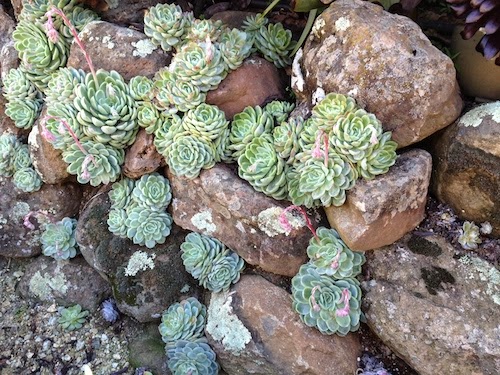
There seems to be no end to the variety of shapes and  sizes of this plant group that includes cacti, as well as echeveria, sempervivens (Hens and Chicks), groundcover sedums, plus aloes and agaves.

Succulents pair well with natural rock features


Use them on the ground in mass plantings, create a rock garden, hanging baskets, or in plant in repurposed containers for interesting focal features. 


Success with Succulents
For low maintenance success you'll need to make sure the soil has excellent drainage, and no chance of remaining soggy. I like to use succulent & cacti planting mix or buy soil for potted plants and mix with lava fines 2:1. Don't fertilize, as a rule. If you must, use very little to kick-start growth then just water periodically when the soil is dry. Avoid keeping them moist which leads to rotting.

It's also important to note the hardiness, or frost tolerance of your selection. If you've fallen in love with a frost sensitive type, make sure you remember to protect her when the cold season approaches.


Photos: Patricia Larenas, Urban Artichoke

Friday, December 17, 2010

Teen Gardener's Passion: Save the Planet

My Aunt first introduced me to gardening when she showed me her vegetable garden. After helping her, my passion about plants and the health of the planet grew. I was inspired to create my own garden; first a vegetable garden, and then of California native plants. I'm starting a tradition for my family of growing native plants, and of following in the Native American's footsteps. I am helping to keep their knowledge of medicinal plants alive by sharing it with others, by collecting seeds, and by giving seeds to my friend Zach to sow. I introduced Zach in 3rd grade to gardening. Even though he moved away in 4th grade, he took his passion with him. We both don't know anyone but each other who garden like we do. Last month I let the flowers on my native plants dry, then collected the seeds, and sent them in the mail to him. Now we both have native plant gardens...

Sophia's Lavender Bee Balm

Continue reading Sophia's story at our new "MV Green Gardener's" web site

Friday, May 7, 2010

Our Flowering Native Californians

One of the greatest joys of our garden transformation is the diversity and abundance of wildlife it has attracted to our home. Here in the San Francisco Bay Area, we are fortunate to be surrounded by beautiful hills and low mountains with lots of preserved open space. The wildlife trickles down into the urban and suburban areas, especially where the right habitat exists. Growing plants native to our area is a sure invitation to the local fauna: different types of wild bees (plus honey bees), butterflies, many species of birds, lizards, and even salamanders. One of my special joys is the nesting pair of California Thrashers that moved in after we took out the lawn in the backyard. Bay Area residents all seem have their favorite stories about close encounters with raccoons, opossums, skunks. and deer (like the time we had a large fluffy raccoon walk into our house, and the possum living in our garage....).

But for the gardener, there are sound arguments for nurturing a diverse garden, instead of a monoculture of lawns (assumes no harmful sprays or other such chemical measures are used).  In our garden we are still in the process of bringing more natives in. The flowers are often spectacular, as shown below (our Matilija poppy shoots flowers skyward ten feet high!) and many of them require very little water or special care, so those attributes are a big incentive.


One of my new favorites we planted last year is a Fremontia bush, from the Los Altos Nursery. Here it is revving up with a profusion of lemon yellow blooms that last into the summer. The bumble and carpenter bees go nuts!


The growing instructions are music to a Californian's ears: don't give extra water in the summer- you'll kill it. Of course for this young bush we gave some additional water last summer, we'll back off this summer. Another newcomer is the ceanothus, "Dark Star", from the Yerba Buena Nursery in Woodside (they sell only native California plants). Here it is covered with blue flowers- a favorite of bees of different types.


Our beautiful California poppies are a "must have". They seem to find their way into the garden on their own and they will reseed, but this year I bought some seeds to encourage them to spread.


This photo shows our classic gold poppies from my backyard, but in my front yard I have yellow and red variants coming in, (sown from seed, below) truly lovely in the sunlight! I saw a pink variety in a garden recently for the first time; I'd love to get some of those.


These wonderful reddish types have really taken to our front yard, much to my delight!


We also have two California Buckeye trees, one in the front yard and one in the backyard. Here is our biggest one bursting into flower in the front yard:


The showy white flowers in spikes have a wonderful perfume. These trees bud out in February, and by late April-early May burst with flowers. They lose their leaves early in the fall, and have beautifully graceful silvery branches for fall and winter.

 As I mentioned, one of the best sources for California natives is the Yerba Buena Nursery.  You can't beat the variety and sheer number of selections, and they have a knowledgeable staff to help. It's a bit of an excursion to get there as they are up on Skyline Blvd. in Woodside, but it makes for a nice outing. When we go up we often stop for breakfast or lunch at the cozy and quirky Alice's Restaurant, right up top where Woodside Road meets Skyline:

The food is good, it's surrounded by redwood trees and it's a mecca for the weekend biker crowd- a must!


The nursery is south of the restaurant, so you take Skyline Blvd. south about a mile or more and look for their sign on the right. Then it's a good mile or two down the narrow road to reach the nursery.

Besides the nursery offerings, they have a garden shop with lots of great books, items for the garden and gifts. They also have a tea shop and host "Farmhouse Teas"on selected dates.

Above: Yerba Buena's extensive selection of California native plants.


Another big plus is the extensive demonstration garden- here you can see the natives in action. They have different areas of established plantings that showcase different habitat types. Check out the beautiful large manzinitas on the hillside (I wonder how old they are?). There is also a pretty pond near a patch of irises. We bought a couple of these to put in our front yard. I was surprised at the many colors to choose from. I am often pleasantly surprised that there are perfectly gorgeous alternatives to non-native plants for the garden! Although gardening with non-natives is not a terrible thing as long as they are not invasive (spread to wild areas via wind or birds) and water hungry, by gardening with species native to our area we provide much needed habitat and nourishment for local wildlife, and for

Pacific Coast Hybrid Iris


                                                     A patch of shade-loving Trillum.

that we are repaid a thousand-fold by being enriched by their presence around our homes, and by creating balance in the garden ecosystem. The garden then becomes truly alive and thriving!