Showing posts with label climate change. Show all posts

Friday, September 21, 2018

Climate Appropriate Gardening and Design


Instead of "drought tolerant" I've adopted "climate appropriate" into my gardening vocabulary. Designing gardens that meet our needs in urban California involves a lot more than just saving on water use. When I'm designing a garden I always aim to create a visually richer, as well as more earth-friendly environment than what I started with. 

The word appropriate aligns especially well to our changing climate and growing conditions: this is the challenge we all face today and for the foreseeable future. And to me it implies that my climate appropriate approach to designing a garden, will adapt to meet the current needs. It's a good reminder to be flexible in my thinking, and to keep informed.
Replacing a lawn is an opportunity to add beauty and diversity
Among many inspirations, landscape architect Thomas Rainer stands out. He champions the cause for bringing more "wildness" into our urban spaces, urgently needed due to the rapid loss of wild spaces. See Rainer in this short video interview here (courtesy of the Pacific Horticulture Society).  

We have the perfect opportunity to add ecological value whenever we are replacing lawns or simply replacing and/or adding plants to our gardens. For example, plant flowering shrubs for your eyes and to feed pollinators- the gorgeous sage (salvia) below is 'Friendship Sage', also known by its original name 'Saliva Amistad'.

Sages (salvias) have lovely flowers in many colors
Hummingbirds love sages, as do bumblebees. This group of plants are generally happy with low to moderate water, even in warm climate zones such as our San Francisco Bay Area. 

In the photo below we designed a long berm with a mix of sages and other flowering plants to create a pollinator garden that would be pleasant to look at from the outdoor patio and from inside the house.  We included an herb garden for fragrance and its value in providing herbs for cooking year-round. 

This low-water garden replaced an unused pool
When replacing pools, lawns, or areas that were previously paved over, I love creating a space that enhances quality of life by being a place to relax and connect with nature. And it's a welcome bonus that adding more plants around homes results in not only beautiful, calming, environments but they mitigate the amount of heat produced by our over-paved urban spaces. Plants transpire water vapor into the local environment, especially trees. So not only do trees provide shade, they actively contribute to cooling. 

In California where the loss of trees due to drought and fires is staggering, we can do our part by planting trees with low and moderate water needs around our homes, as many as possible. 

A quiet seating area with flowering sages replaced bare soil
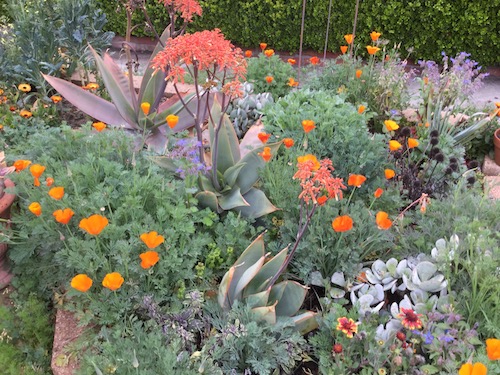
Below, wildflowers in a front yard meadow garden provide a spectacular seasonal display.


I'm also a big fan of growing seasonal edibles at home, and when we save water by replacing lawns or pools with a low water garden, we can feel good about using some water on our special heirloom vegetables. Growing our own food not only connects us to the seasons but can also remind us of our heritage and culture. Heirloom vegetable seeds are readily available from many sources. It's meaningful and satisfying to learn their stories and enjoy them with our families and friends by growing them.

Many fruit trees are perfect for low to moderate water gardens: avocado, plum, pluot, apple, persimmon, pomegranate and pineapple guava. Check my gardening index for more on edible landscaping.

'Four Corners Gold' bean in my front yard last summer
For more information and resources about climate appropriate landscaping go here.

Photo credit: Patricia Larenas

Sunday, July 13, 2014

Saving Seeds with Our Hands and Our Hearts

"Institutions do not save seeds- humans with hearts do."
- Dr. Gary Paul Nabhan, 2013 Annual Conference and Campout, Seed Savers Exchange

Recently I re-read the transcripts of speeches given by some of the keynote speakers from the 2013 Seed Savers Exchange Annual Conference. I admit to getting particularly misty-eyed by Dr. Gary Paul Nabhan's speech.  It hit home how important it is to sow our seeds, save them, and pass them on to our family, friends, and neighbors, and to keep them safe for the next generation.  As he explained, it's not some retro, quaint activity and a hanging on to the past, saving seeds is about the future. And beyond the seeds themselves it's about our connections to our culture and our links as a community, and to the earth. 

Why We Should Care
The loss of biodiversity of many types is a hot topic these days, and it certainly applies to seeds from our favorite edibles. As for me, I'm not willing to depend solely on seed companies as a source for the edibles I've come to love and count on and look forward to each season. And more urgently, our changing climate and other environmental pressures demand that we keep a pool of diverse food sources ready to meet changing growing conditions.

We don't have to settle for less, and we do have the ability to shape our futures.


The strikingly colored Christmas Lima, available from SSE

Seed Savers Exchange 34th Annual Conference and Campout
Pumped with these energizing thoughts, I'm really excited that I'm finally going to make the trip out to Iowa this year for the Seed Savers Exchange 34th Annual Conference and Campout in Decorah, Iowa.  The conference is July 18 to 20th, with a members only day on Friday. I can't wait to see the test gardens and the seed saving operations at Heritage Farm after reading about them for several years!

Maybe the best part is that I'll be spending hours and days with my people: like minded gardeners, farmers, and dedicated seed conservationists. No chance of boring anyone with lengthy conversations about seeds and their stories, or the nuances of various bean varieties, or the ideal isolation distances for lettuce, etc.


Flower: Little Lady Bird Cosmos; bean: Rattlesnake, a pole bean

We Can do Nothing or We Can do What We Can
Check out this nice graphic from National Geographic. It's sobering and even frightening. It illustrates the findings from a study done in 1983 that found a 93% loss of crop varieties since 1903 (of 66 crop types). 

They became extinct.

Photos: Patricia Larenas, Urban Artichoke